Show-and-Tell
When I was an early childhood teacher, I often included the popular practice of Show-and-Tell in my class’s daily routine. At circle time, each child could show an item and tell something about it. Sounds simple enough, but I soon realized the pitfalls of Show-and-Tell. Giving everyone a turn was tedious for wriggly four- and five-year-olds. Tears resulted when a child (or busy parent) forgot the item. Envy occasionally sprouted when a particularly popular toy was unveiled. I began to modify Show-and-Tell, assigning children a specific day and establishing rules about what children could and could not bring and whether they must share the item, lest arguments ensue. Show-and-Tell often devolved into something more aptly described as Bring and Brag. Show-and-Tell didn’t work well in groups where some children came from well-equipped homes and others did not. Look what I have was the unspoken message of many Show-and-Tell circles.
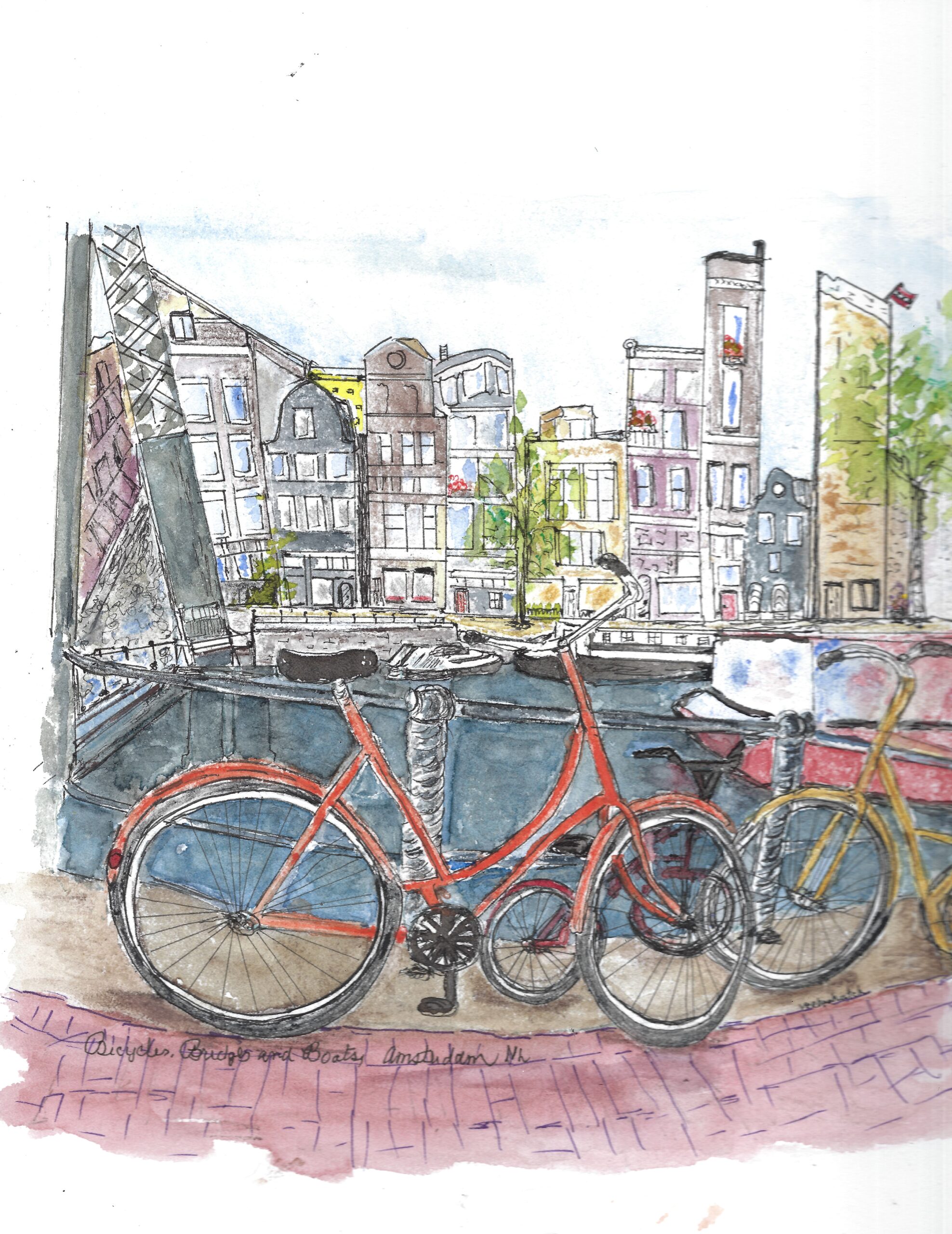
Looking back upon this simple activity, I wonder just what we teachers hoped to achieve. The original idea behind it was to give each child a chance to practice language skills and build confidence, but there were plenty of other activities that better fit the bill. As teachers realized the built-in issues with this activity, the practice fell out of favor at my school. I soon bid a not-so-fond farewell to Show-and-Tell in my classroom. Despite all this, I am reviving this dubious practice with a new G-rated adult version of Show-and-Tell. For “circle” time I offer an updated version of Show-and-Tell complete with modern technology: a digital scan of a recent picture shared with you– my circle of readers.
This ink and watercolor wash picture Bicycles, Bridges and Boats captures a quintessential Amsterdam street scene. Its source is a photo I took a few years ago while on a visit to family who are long-time residents of Amsterdam. The scene is just a few steps from my family’s home in the old section of Amsterdam known as the Jordaan. The tangle of bicycles, so typical of Amsterdam’s crowded streets, includes a couple of bikes that belong to my relatives. If I were called upon in our “circle”, I would have plenty to say, though I insist that my sharing is not a case of Bring and Brag. My Show-and-Tell today is influenced by a bit of artistic advice I’m applying to my creative efforts. An accomplished artist recently spoke about the purpose of any artwork, from a beginner’s amateur effort to a polished professional’s high-priced masterpiece. [I summarize, rather than quote]: In order to be genuine, your art, no matter what medium you choose to work in, no matter your skill level, must either tell a story or evoke a mood-or both! After hearing this gem, I began to look at my projects through a new lens. Now when I make observations or review photos, instead of thinking– That’s an interesting composition, or This could help me practice my shaky drawing skills– I ask myself: Why am I drawn to this particular image? Could a viewer uncover (or create) a story behind the brush, pen or pencil strokes? Would he/she catch a fleeting mood or sense an emotion? This fresh way of seeing images shapes my choices of potential subjects. Specifically, in creating Bicycles, Bridges and Boats, I looked anew at a favorite old photo that was currently entombed in my phone’s “Gallery”. I studied it, cropped the image, and began to compose the painting. As I worked, a story took shape. It’s the story of a lifestyle very different from my own, but one that is perfect for those I love. As I look at the little green bicycle that is long since outgrown, I picture a bright-haired little boy diligently pedaling alongside his parent’s orange bike as they weave through the crowded Amsterdam streets. The dilapidated red and white boat makes me laugh. I easily recall that make-shift houseboat where a wizened old man lives with his 12 or 13 dogs. The canines perch on top of the deck, patiently (and noisily) waiting for their owner to leash them up and assemble the motley crew for their morning walk… errr… parade… down the cobblestone streets. The picturesque canal bridge leads to a nearby neighborhood where an outdoor market teems with locals and tourists gathering up flowers, vegetables, breads and cheeses. With each detail added, the story takes shape for me. I know that those who look at it are not aware that these bicycles are special. Viewers don’t know about the red boat’s eccentric resident or can picture themselves crossing that bridge to wander towards a bustling open-air market. My hope is, nevertheless, that there is a story embedded in these colors, lines and shapes. My hope is that feelings of curiosity, nostalgia, or enjoyment will seep out of the picture as imaginations soar.
I’m rather late to latch on to these well-known artistic guidelines, but better late than never. I come to an obvious conclusion: To be authentic, art must first tell us a story or engage our emotions. We must look with more than our eyes, whether an artist or an observer. When we do, art becomes more than a method, more than materials, more than a topic. In my quest to master technique and improve my skills, I can easily lose sight of all of this. Genuine art is not always about artistic prowess or reputation. I freely admit that my art has sometimes followed a principle succinctly stated by Sgt. Joe Friday in the old Dragnet TV series. Just the facts, ma’am, he would say when a witness would veer off into story-telling or seethe with emotion while describing a crime. I hope that Just the facts– color choices, , value, perspective—no longer fully describes my art. Whether portraying a yellow cactus flower, sketching a branch of near-to-budding pear blossoms, or painting a busy Amsterdam scene, I paint a story. I draw feelings. Sometimes that story is discernible only to me. Sometimes it is only I who feel emotion as I work. Without those elements, my art lies flat and lifeless, mere scratches on paper, fancy though those marks may be, colorful as the pigments are. In pivoting my art this way, I find a deep satisfaction, no matter what my current skill level dictates.
With today’s Show-and-Tell, I neither boast nor brag. This is truly quite a simple painting crafted by an ordinary hand with common materials. I must not make it more than it is. Lest I burden this little essay with too many lofty goals:
I simply hope that it makes you smile.
Art is in essence a visual medium, but for it to connect with both the artist and the viewer, that vision must go deeper than the surface upon which it rests. Thanks for sharing circle time with me.
It is only with the heart that one can see rightly.
What is essential is invisible to the eye.
–from The Little Prince by Antoine de Saint-Exupéry2.
1 Bicycles, Bridges and Boats original artwork ©Beth Hatcher. May not be reproduced without the written permission of the artist
2 Quote from The Little Prince by Antoine de Saint-Exupery