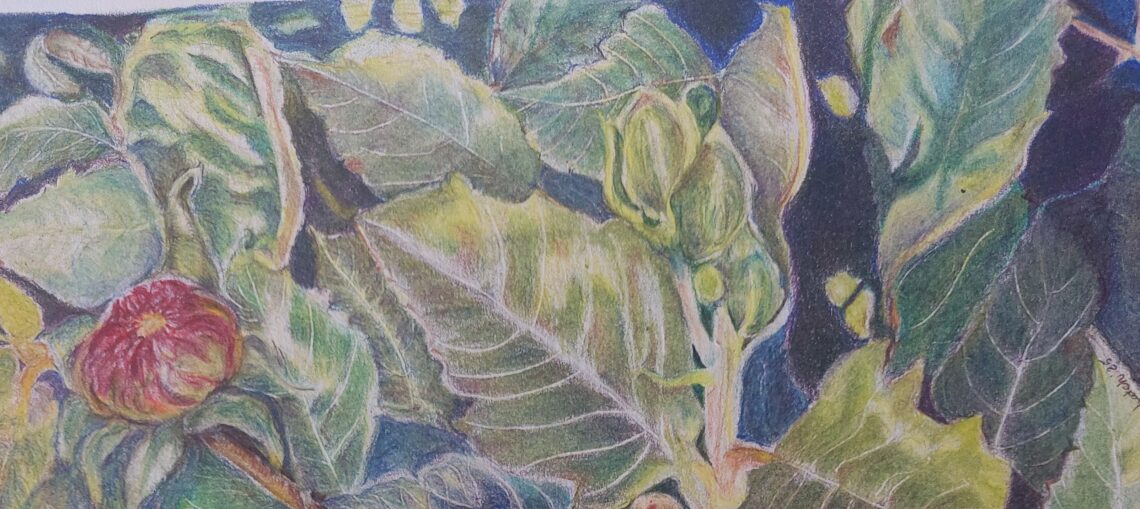
It’s Not Easy Bein’ Green
The assignment for my botanical art class was apparently simple. As we neared the end of our class exercises focusing on how to depict realistic colors with colored pencils (my chosen medium), the instructor gave us our instructions for the final project:
Draw and color something green.
We were to choose a botanical subject and then match the greens of our drawings to it. Any plant or portion of a plant that included the color green would work for this assignment: a lime, an oak leaf, a stalk of broccoli, a cactus paddle… The importance of mastering accurate green colors in botanical art is critical. No matter how artistically a red rose or orange hibiscus is portrayed on canvas or paper, if the surrounding leaves and stems are off-color or artificial in appearance, the botanical portrait will suffer.
I quickly chose my subject: the deep green leaves of a lantana plant. I would soon be entering a drawing in a local art show. I could not only get started with my artwork, but also get feedback from my expert instructor. Even though lantana bushes are dry and dormant at this time of year, I had plenty of reference photos from last summer’s garden. I assembled a large assortment of green colored pencils, carefully chose my paper and began to work.
I quickly discovered that matching greens, as in combining colors to capture the nuances, tints and shades of a particular green leaf, was neither easy nor clear cut. Was the underlying color of that lantana’s leaf forest green, juniper green, olive green? Were the highlights earth green, sage green, or chartreuse? Should I create a unique shade of green using blues and yellows? I was soon lost in the land of greens, surrounded by dozens of color choices, but not quite able to duplicate the lantana’s pillow-soft texture, much less to capture its luscious blue-green shade or delicate veining patterns.
Hours of work later, I laboriously completed one lantana leaf. Sigh. I’m re-thinking my ambitious goal of entering the art show. Time to change focus, physically and mentally. Instead of peering intently at my work table strewn with pencils and paper, I turn towards my current Lenten meditations, knowing I will uncover something that fits the moment. Not surprisingly (for me anyway) a snippet of song enters my brain, along with the image of an oddly green-hued, fuzzy, and famous frog. I nod my head in agreement as I listen to my internal music recorder play Kermit the Frog’s Sesame Street ballad, Bein’ Green. I totally agree with Kermit’s lament about the challenges of bein’ green (different) and easily apply it to my current challenge: It’s not easy bein’ green, (especially if you are trying to capture green’s shades with mere pencil and paper).
Rather than begin another drawing—I’m not quite up for that– I take a step back from the absorbing, detailed work of colored pencil art and widen my view. Outside my studio window, the brown carpet of grass is showing a slight green tinge. Around the corner, green’s appearance on the stems of my newly planted plum tree seems almost magical. The stiff brown branches of the tree we brought home from the garden store less than a week ago are now almost glowing in the sunlight. Is that chartreuse that is appearing alongside the brown? I have a pencil that color!
Art, and especially colored pencil art, offers the opportunity to notice things closely, to look deeply at detail, so discover the nuances of beauty that combine to make something unique. Botanical art takes that a step further, and entices us to come closer, to look more intently, to notice the complexity of form and color that is inside every flower, every leaf. The Lenten season does the same, offering opportunities to look closely, to study intently, and then, to step back for a view of the bigger pictures within which all of us exist.
This time of year, nature’s changing shades of green are everywhere. Green is growth; Green is sustenance; Green in rejuvenation; Green is, simply, life itself. Those pastures that God as our Shepherd wants us to lie down in? Green, of course.
It’s not easy bein’ green, in art or in life. It’s not easy to tackle a difficult art project. It’s not eay bein’ willing to grow, to change, to turn from something stiff and half-dead into something pliable and growing. It’s a challenge for sure, but it’s not impossible, never that. There’s no way to avoid bein’ green if I want to be a botanical artist… and there’s no way to avoid it if I want a vital and dynamic future.
O God who created myriad greens in the natural world, keep my soul green as well, ready to grow in response to your nurturing care. Amen.
Psalm 23:1-2
The Lord is my Shepherd. I shall not want. He makes me lie down in green pastures; He leads me besides still waters. He restores my soul. NIV
Snippet of original artwork by Beth Hatcher 2025.

2 Comments
Susan Marlin
Beautiful ❤️
Laura Vaughan
I love that you are able to take the simple word ‘green’ and turn it into a beautiful message.